
Cloth & pattern
Tie patterns explained
Every tie pattern has a home — the boardroom, the racecourse, the shoot, the wedding. Know where it comes from and you will know where to wear it.
Most tie patterns began somewhere in particular — paisley in Persia and Scotland, stripes in the regiment and the club, tartan in the Highlands, pheasants in the field. Most now travel freely; a few are still best kept close to home.
Plain and herringbone
A plain silk tie is the most useful tie a man can own and the hardest to get wrong. It is right for interviews, funerals and weddings, and it partners any patterned shirt or pocket square.
Plain needn’t mean flat. Herringbone — a woven zigzag, named for the bones of a herring — gives a solid colour texture and depth, so a herringbone tie in rust, copper or gold suits tweed as well as worsted.
If you are building a collection from nothing, start with plain navy and plain wine. Between them they cover more occasions than any pattern.
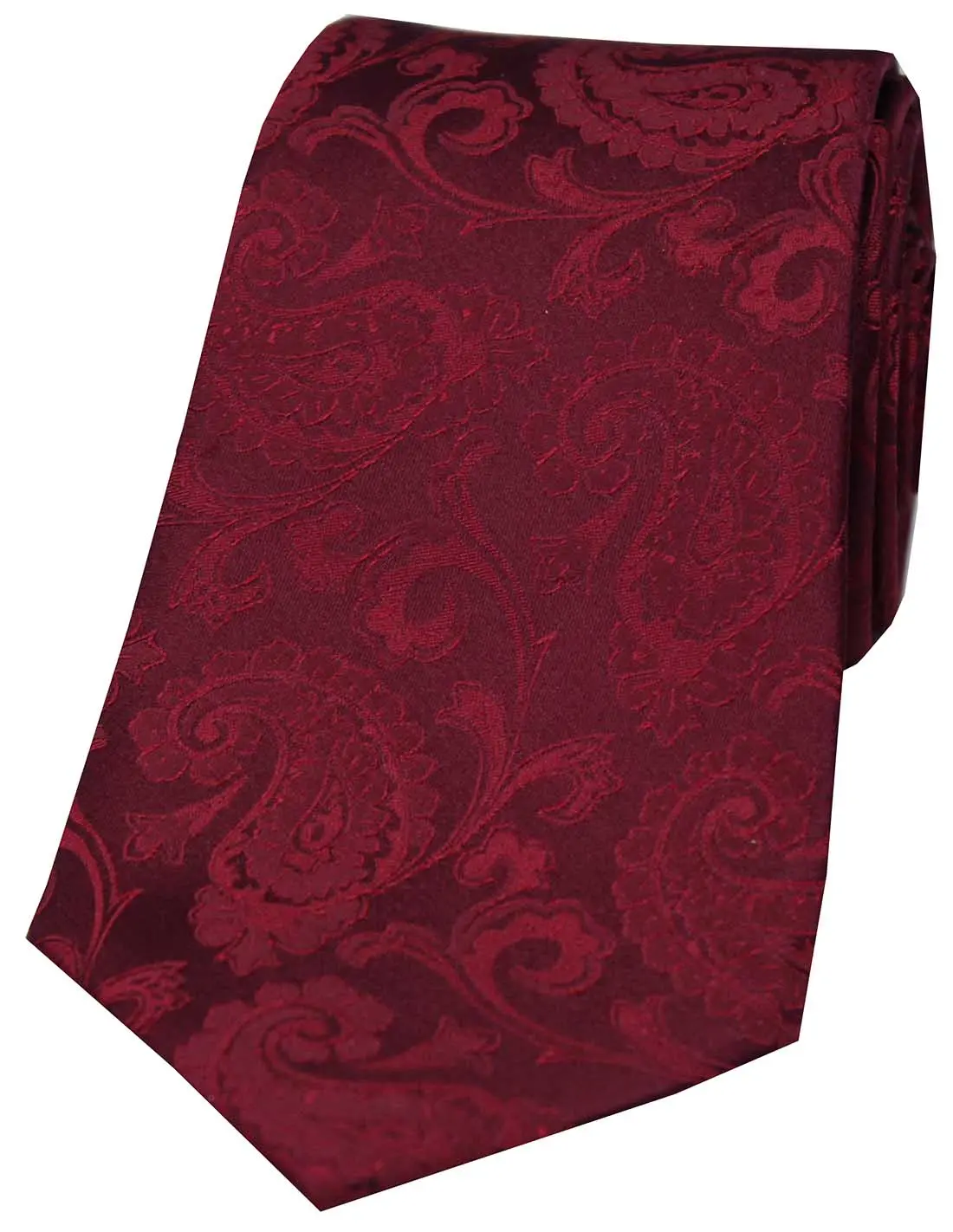
Paisley
The curled teardrop is the buta, a Persian and Indian motif that reached Britain on Kashmir shawls in the late eighteenth century. Weavers in the Scottish town of Paisley, west of Glasgow, copied it so widely in the nineteenth century that the pattern took the town’s name.
Paisley is the great all-rounder: grave enough for the boardroom in navy or wine, festive enough for a wedding in gold or blue, and the classic pattern for a cravat. A wine paisley on a navy suit is about as safe as a patterned tie gets.
Dots
Pin dots are the smallest, little more than a texture at a distance, and they read almost as plain. A navy and white pin dot is a business tie that never draws comment.
Polka dots are larger and more cheerful; they took their name from the polka, the dance craze of the mid-nineteenth century. The bigger the spot, the less formal the tie, so keep large spots for weddings, parties and summer, and wear a navy tie with white polka dots almost anywhere.
Stripes
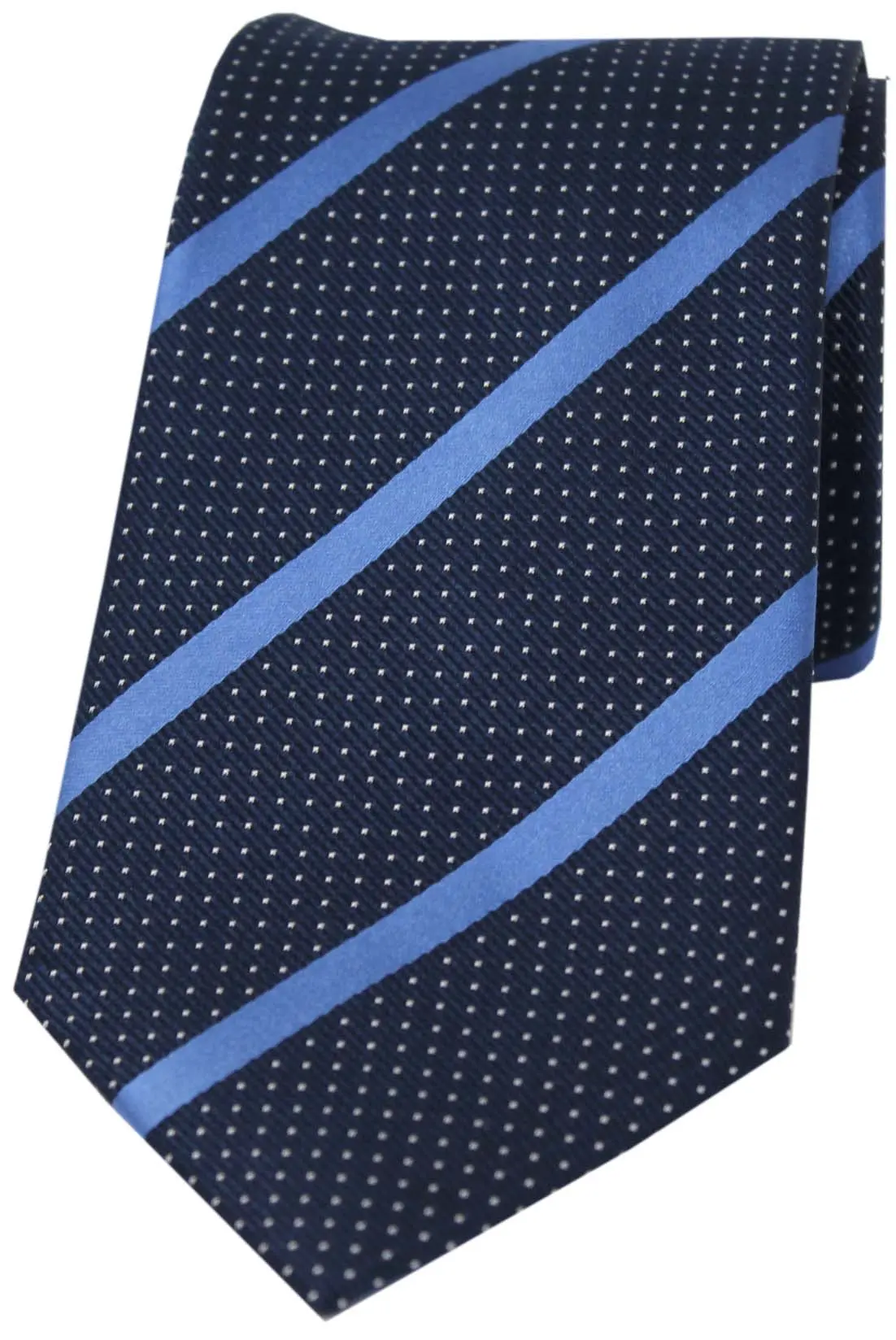
Diagonal stripes began as the colours of regiments, schools and clubs, and a true regimental or club tie still belongs to its members. A fashion stripe belongs to anyone, but if a stripe looks like a regiment’s colours, it is worth knowing whose they are.
By common convention, British stripes run down from the wearer’s left shoulder towards his right hip, and American makers turned them the other way. There are exceptions on both sides of the Atlantic, so treat it as a tendency rather than a law.
Striped ties are business ties first. Wear them with a plain shirt, or with a shirt stripe of a very different width — more in how to match a tie to a suit and shirt.
Neats and florals
A neat is a small, tidy repeat — squares, diamonds, circles — set evenly on a plain ground. It is the office pattern: from across the room it reads as a colour, from across the desk as a pattern. A neat box pattern on a wine ground will go to any meeting — and, at most meetings, nobody will remember it, which is often the point.
Floral ties run from small flowers scattered on a dark ground to the bold, many-coloured silks of Posh & Dandy. Small florals will do for the office; large ones are for weddings, summer and the races.
Tartan and country motifs
Tartan belongs to Scotland and to winter. Many tartans are linked to a clan, a family or a place, and they come into their own on Burns Night, at Christmas and through the cold months, with tweed or a plain dark suit.
Country motifs — pheasants, Labradors, horses and jockeys, fishing flies, shotgun cartridges — are the patterns of the British countryside. Scattered small on a dark ground they read almost as a neat, which is why a country tie passes in town as well as at a shoot; see country ties explained.
Which pattern, where
The more formal the occasion, the smaller and quieter the pattern. The table gives the usual conventions; the event’s own dress code, where it has one, comes first.
| Occasion | Patterns that suit | Best avoided |
|---|---|---|
| Interview | Plain, pin dot, small neat, quiet stripe | Large florals, novelty |
| Business | Neat, stripe, paisley, polka dot, herringbone | Anything you would have to explain |
| Wedding guest | Paisley, polka dot, floral, plain in a colour | Plain black |
| Funeral | Plain black, or very dark and plain | Anything bright or busy |
| The races | Floral, polka dot, racing motifs, bright paisley | Sombre black |
| Shoot or country | Game birds, dogs, tartan, herringbone, wool | Shiny satin, large florals |
Questions
Anything else? Call us on +44 (0)20 3232 5900
Where does the paisley pattern come from?
The motif is the buta, a curled teardrop from Persia and India that reached Britain on Kashmir shawls. Weavers in Paisley, in Scotland, copied it so widely that it took the town’s name.
Which way do the stripes run on a British tie?
By common convention, down from the wearer’s left shoulder towards the right hip; American stripes usually run the other way. There are exceptions on both sides, so treat it as a tendency rather than a rule.
What is a neat tie?
A tie with a small, evenly spaced repeat — squares, diamonds or circles — on a plain ground. It reads as a colour from a distance and is a classic business tie.
Can you wear a patterned tie to a funeral?
It is safest not to. A plain black or very dark tie is the convention, unless the family has asked for something else.
Related
 5 min readHow to match a tie to a suit and shirtThree rules carry most men through: the tie darker than the shirt, a colour the suit doesn’t already have, and one bold pattern at a time.
 5 min readSilk ties explainedTwo ties can share a colour and a width and still be nothing alike. The difference lies in how the silk was made and what is sewn inside it.
 5 min readCountry ties explainedGame birds, Labradors, horses, fishing flies and shotgun cartridges — what makes a country tie, and how to wear one with tweed, at a shoot, at the races and in town.